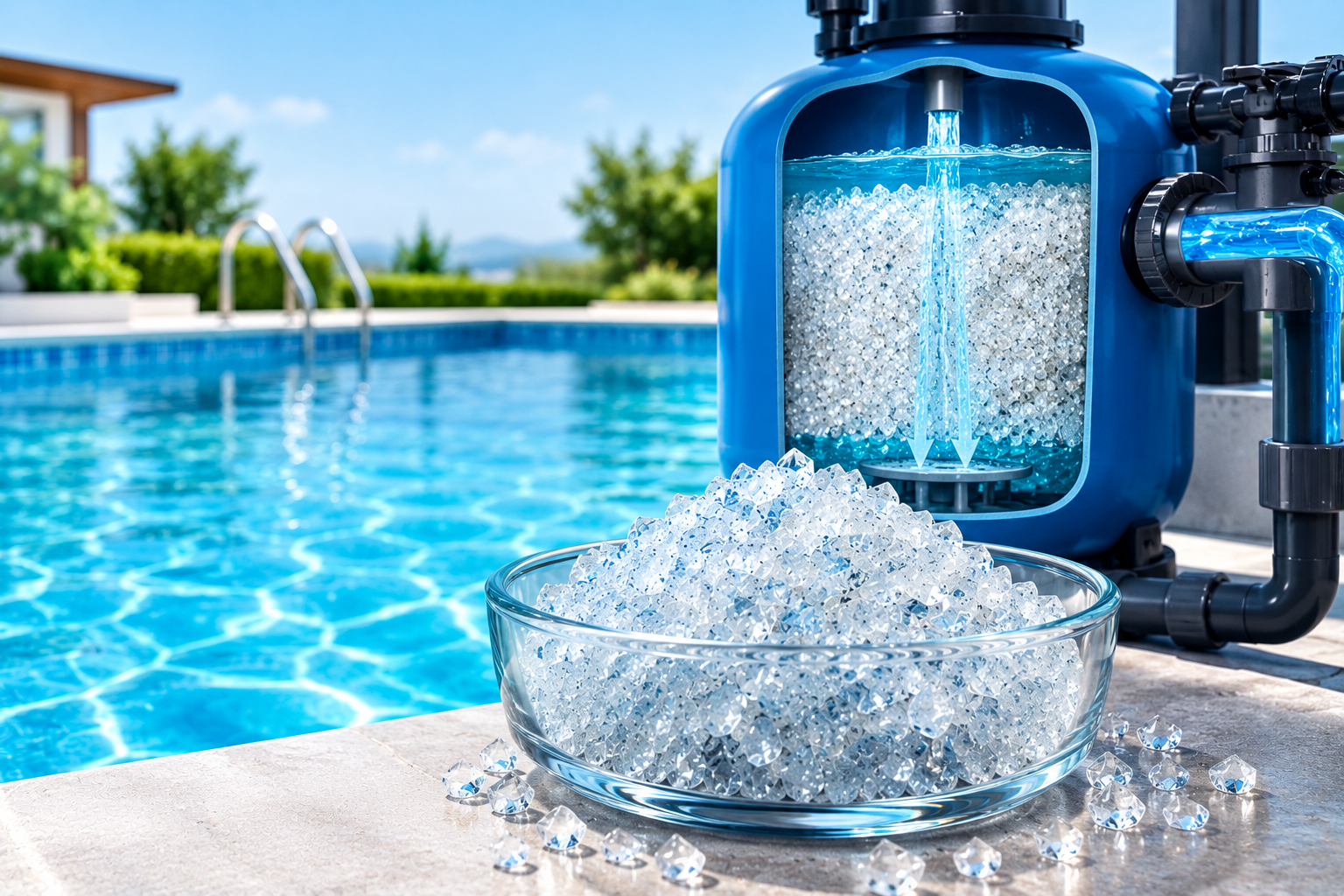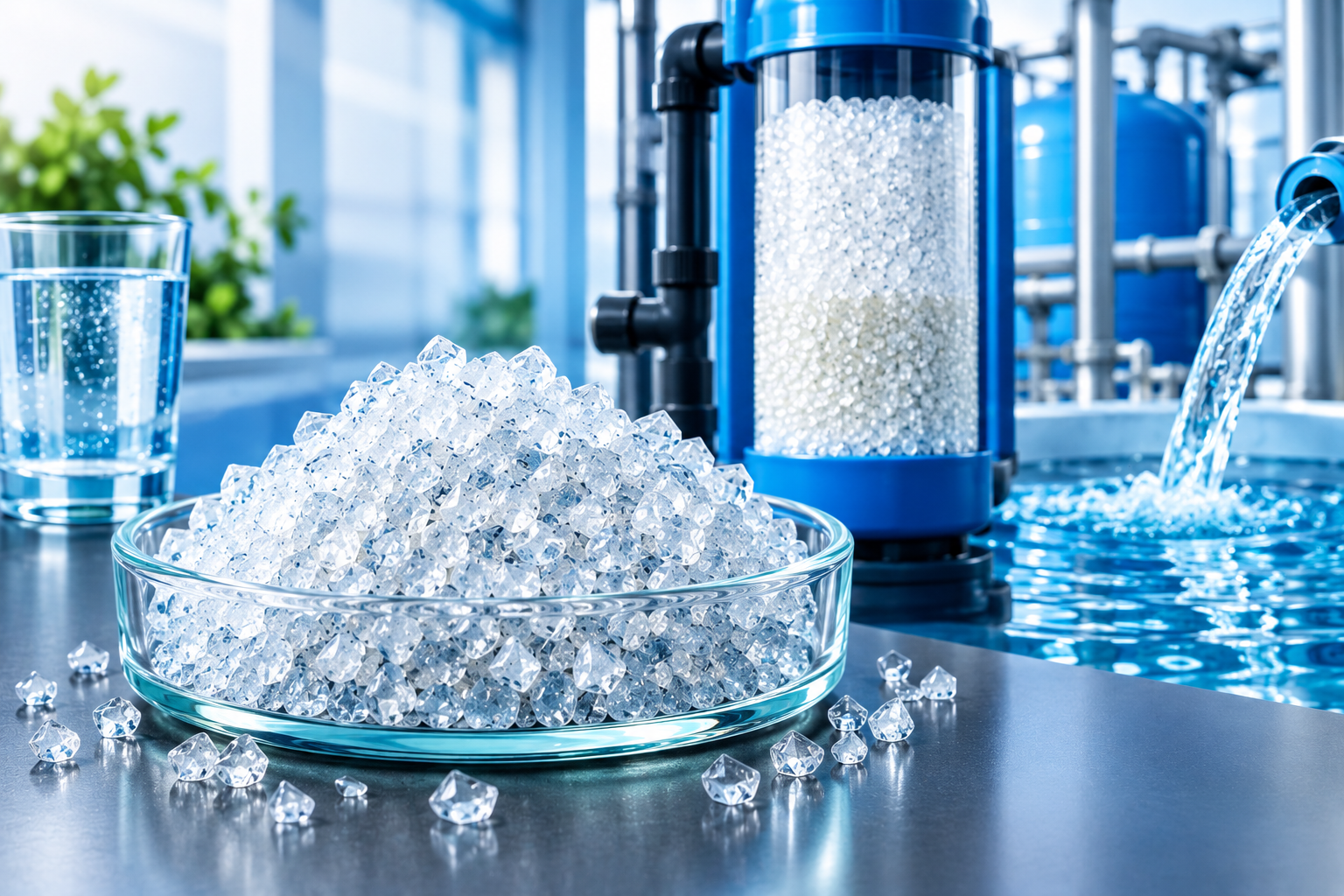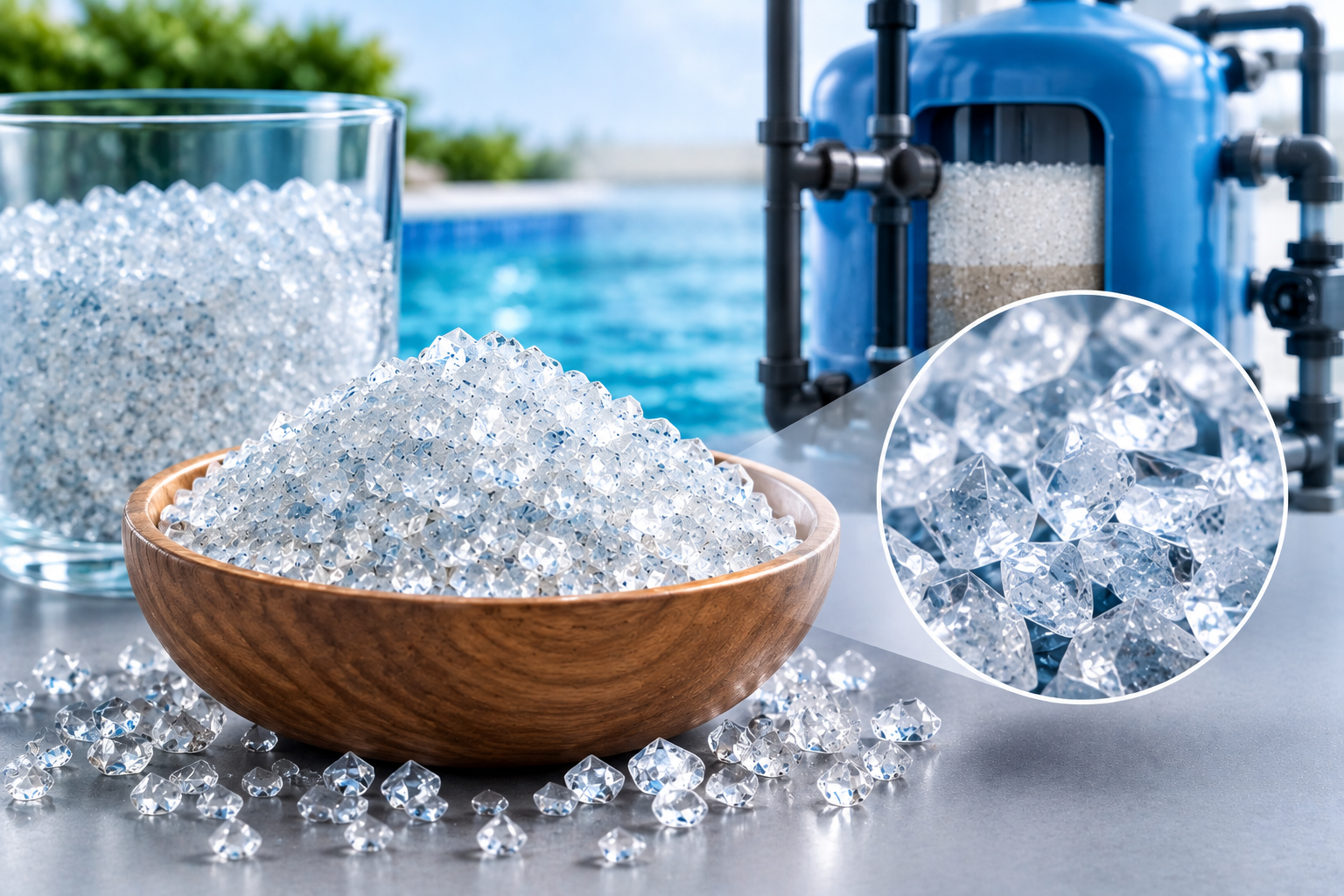

The use of crushed and processed glass as a filtration media for water treatment improves water clarity and quality and provides a suitable alternative to silica sand in both saltwater and freshwater swimming pools.
Benefits of Glass Filter Media in Swimming Pool Water Filtration
Today, the use of glass filter media in swimming pools and water treatment systems has become widely accepted as a suitable alternative to conventional silica sand. Crushed glass has unique properties that make it an effective choice for filtration.
Crushed glass is an amorphous (non-crystalline) material with no grain boundaries or rough surfaces. As a result, glass filter media does not reduce filtration efficiency, while the smooth surface of the glass particles significantly reduces the potential for algae and fungal growth.
Unique Properties of Glass Filter Media
Glass has a polar surface due to the presence of negatively charged hydroxyl ions, which can weakly attract positively charged contaminants. Positively charged ions or manganese particles that become adsorbed onto the glass surface can be removed through proper filter backwashing.
Glass is a synthetic material and contains insoluble components, unlike conventional silica sand, which may contain small amounts of shale or carbonate rock. In an acid solubility test, the weight loss of silica sand should be no more than 3%, whereas the weight loss of glass filter media is significantly lower.
Acid solubility testing is used to assess the durability of filter media particles. It indicates the extent to which particles wear down and break into finer particles over the service life of the filtration media. The structural integrity of glass particles provides a higher degree of uniformity within the filter media.
Glass Filter Media Quality Standards
ASTM C88 includes a magnesium sulfate soundness test, which is used to evaluate the durability and stability of aggregate materials. Glass has also demonstrated better performance than sand in this test.
Glass filter media has been able to maintain its particle size and uniformity coefficient during testing. Its smooth surface, low abrasion rate, and resistance to breaking down into finer particles provide better permeability compared with silica sand.
This characteristic helps prevent channeling and partial clogging within the filter bed over time. As a result, glass filter media remains stable for longer periods and requires less frequent replacement.
Comparison of Glass Filter Media and Silica Sand
In general, because there are significant differences among different types of silica sand and the various techniques used to manufacture glass filter media, a direct comparison between the two materials may not always be appropriate.
When silica sand is used, significant variations in geological characteristics can affect its chemical composition and particle angularity, and consequently influence its overall effectiveness as a filter bed.
By contrast, the properties of glass filter media are generally similar to those of glass bottles or other glass materials. However, depending on the processing method used to manufacture glass filter media, differences in processing techniques can affect contaminant carryover, particle size, and media uniformity.
Glass Filter Media Preparation and Sterilization Process
Laboratory-grade mineral materials are used to develop the preparation and sterilization process for glass filter media.
First, a process based on uniform external pressure, rather than impact breaking, is used to produce the raw material—crushed glass. This process is designed to produce particles with a more uniform size and improved permeability.
The glass is then sterilized using heat to eliminate organic contaminants and destroy microorganisms.
This unique crushing process allows extremely fine particles to be completely removed. As a result, glass filter media can be graded according to the specific requirements of the filtration system.
An easy demonstration of the quality difference can be performed by placing a handful of the new glass filter media into a zip-lock bag and shaking it thoroughly. Fine particles will be clearly visible at the bottom of the bag. This simple test makes it easy to observe the difference in the quality of glass filter media.
The crushed and processed glass is graded according to optimum particle size and is then sterilized at a temperature of 500°F (approximately 260°C).
Conclusion
The use of glass filter media in swimming pool water filtration has attracted considerable attention as a suitable alternative to silica sand due to its unique properties, including a smooth surface, low abrasion, and improved permeability.
By reducing the need for media replacement and improving filtration system efficiency, glass filter media provides an effective solution for maintaining clear, high-quality swimming pool water.